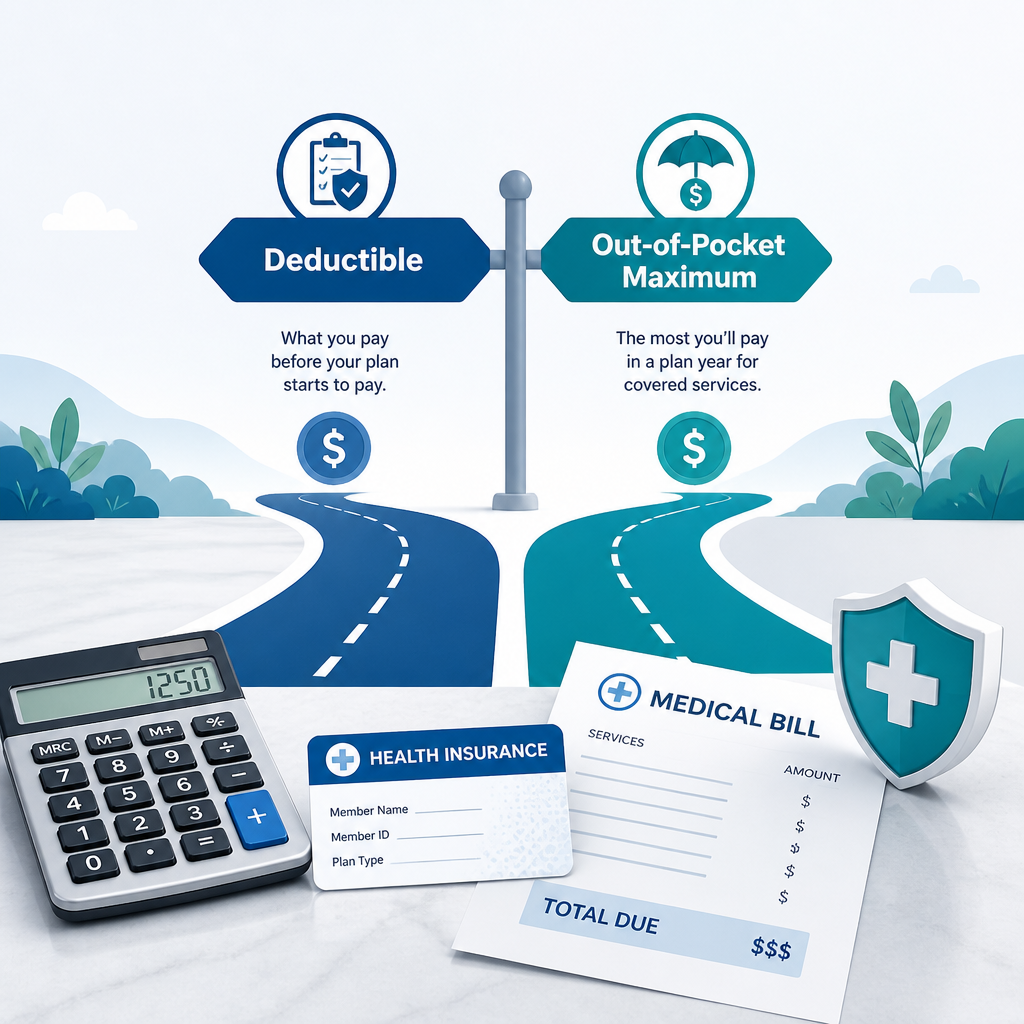
Understanding deductible vs out-of-pocket maximum can help you estimate what a health insurance plan may cost before you enroll or receive care. These terms describe different parts of your financial responsibility. The deductible usually affects what you pay early in the plan year, while the out-of-pocket maximum limits certain covered costs after you have paid enough. However, the details depend on your plan, network, services, and benefit documents.
Health insurance language often feels more complicated than it needs to be. A plan may list a monthly premium, deductible, copay, coinsurance, and out-of-pocket maximum in the same summary. Those numbers work together, but they do not mean the same thing. Learning how each one works makes it easier to compare plans, review medical bills, and prepare for a high-cost year.
This guide explains the difference in plain language. It also shows how to calculate possible costs, what typically counts toward the limits, why in-network care matters, and which questions to ask an insurer before you choose a plan. Health Insurance Terminology Guide: Deductibles, Copays, Coinsurance, and Out-of-Pocket Maximums
Deductible vs Out-of-Pocket Maximum: The Basic Difference

The simplest way to remember the difference is this:
- Deductible: The amount you generally pay for covered services before your plan begins paying according to its cost-sharing rules.
- Out-of-pocket maximum: The most you generally pay during a plan year for covered services from in-network providers, subject to the plan’s rules.
These are not interchangeable numbers. A deductible may be several thousand dollars, while the out-of-pocket maximum is often higher. Once you meet the deductible, you may still pay copayments or coinsurance. Those additional payments may continue until you reach the out-of-pocket maximum.
For example, imagine a plan with a $2,000 deductible and a $6,500 in-network out-of-pocket maximum. You may pay the first $2,000 of applicable covered care yourself. After that, the plan may pay part of the cost while you pay a copayment or coinsurance. If your qualifying spending reaches $6,500 during the plan year, the plan generally pays the full allowed amount for covered in-network services for the rest of that year.
This example is only an illustration. Actual plans can treat office visits, prescriptions, preventive care, emergency services, and family expenses differently. Always read the plan’s Summary of Benefits and Coverage and related documents before relying on a specific number.
What Is a Health Insurance Deductible?
A deductible is the amount you may need to pay for certain covered health services before your insurer begins sharing those costs. If your deductible is $1,500, you may be responsible for the first $1,500 of eligible expenses that apply to the deductible. Afterward, the plan may begin paying its stated share.
The deductible usually resets according to the plan year. Many plans use a calendar year, but some employer plans follow a different schedule. A deductible can also apply separately to medical care and prescription drugs, or the plan may use one combined deductible. The plan documents should explain which structure applies.
What may count toward the deductible?
Covered, deductible-eligible expenses often include services such as hospital care, diagnostic tests, procedures, imaging, and specialist visits. Yet not every service necessarily applies. A plan may cover certain primary-care visits or generic prescriptions before you meet the deductible. It may also have separate rules for preventive services.
Your insurer usually calculates the amount using the plan’s allowed amount rather than the provider’s full billed charge. If you use an in-network provider, the negotiated allowed amount may be lower than the original bill. If you use an out-of-network provider, the plan may use a different amount, cover less, or exclude the service altogether.
What does not usually count toward the deductible?
Monthly premiums generally do not count toward the deductible. Premiums are the recurring payments you make to keep coverage active. They continue whether or not you receive medical care.
Other expenses may not count either. Common examples can include noncovered services, amounts above a plan’s allowed charge, out-of-network costs under a plan that does not recognize them, and balance bills from providers. A plan may also exclude certain fees or services from deductible calculations. The safest approach is to check the explanation of benefits or contact the insurer.
What Is an Out-of-Pocket Maximum?
An out-of-pocket maximum is a limit on what you pay during a plan year for covered services that qualify under the plan’s rules. After you reach that limit, the plan generally pays 100% of the allowed amount for covered in-network benefits for the remainder of the plan year.
The phrase “allowed amount” matters. The limit does not necessarily cap every healthcare-related expense. It usually applies to covered benefits and may require you to use in-network providers. Premiums, noncovered services, and charges above the allowed amount commonly do not count. Neither do all out-of-network expenses, depending on the plan.
Suppose your plan has a $5,000 out-of-pocket maximum. You pay $1,500 toward the deductible, then make qualifying copayments and coinsurance. If those eligible payments total $5,000, you have reached the limit. You may still owe your monthly premium and costs for services the plan excludes. However, qualifying covered in-network care should generally receive the plan’s highest level of payment for the rest of the plan year.
Why the maximum provides protection
The out-of-pocket maximum can reduce the risk of unlimited cost sharing for covered care. Without such a limit, a long hospital stay or serious illness could leave you paying a percentage of every covered bill. With a limit, you can estimate a worst-case amount for eligible in-network services, although the premium and excluded costs remain separate.
This protection works only within the plan’s boundaries. You may pay more if you receive care outside the network, choose services that are not covered, fail to follow authorization rules, or receive a balance bill. Emergency care may have special protections or plan rules, but you should still review the claim and contact the insurer if the billing appears incorrect.
How the Two Numbers Work Together
The deductible is usually one stage of cost sharing. The out-of-pocket maximum is the broader ceiling for qualifying cost sharing. Your deductible payments may count toward the out-of-pocket maximum, but meeting the deductible does not automatically mean you have reached the maximum.
Here is a simplified progression:
- You pay your premium to maintain coverage.
- You receive covered care and pay the amounts assigned to you under the plan.
- Eligible payments apply toward the deductible until you meet it.
- After the deductible, you may pay copayments or coinsurance.
- Eligible cost-sharing payments continue to accumulate toward the out-of-pocket maximum.
- After reaching the maximum, the plan generally pays the full allowed amount for covered in-network services for the rest of the plan year.
Not every plan follows this sequence for every service. Some plans charge a copayment before the deductible. Preventive care may receive special treatment. Prescription benefits may use tiers or a separate deductible. Therefore, use the progression as a framework, not as a substitute for your plan documents.
A Worked Example of Deductible and Out-of-Pocket Costs
Consider a hypothetical individual plan with these terms:
- Monthly premium: $320
- Annual deductible: $2,000
- Coinsurance after the deductible: 20%
- In-network out-of-pocket maximum: $6,500
During the year, the member has an in-network procedure with a plan-allowed cost of $8,000. Assume the procedure is covered and the member has paid nothing toward the deductible. Term Life vs. Whole Life Insurance: Which Coverage Fits Your Financial Plan?
First, the member pays the first $2,000 because that amount applies to the remaining deductible. The plan then processes the remaining $6,000 under the coinsurance rule. At 20%, the member owes $1,200, while the plan pays the remaining allowed amount under the policy.
The member’s qualifying cost sharing for this procedure is $3,200. That amount includes the deductible and coinsurance. It does not include the monthly premium. If the member later receives more covered in-network care, additional qualifying payments may continue toward the $6,500 out-of-pocket maximum.
Now change the example. Suppose the member had already paid $5,800 toward the maximum before the procedure. The member may have only $700 remaining before reaching the $6,500 limit. The plan’s processing rules determine how the claim applies, but the member would not necessarily pay the full $3,200 in that situation.
This example leaves out copayments, prescription costs, provider billing issues, and services that do not qualify. Real claims can also process across several providers. Still, it shows why both numbers matter when estimating annual exposure.
How to Compare Plans Using These Numbers
Choosing a plan based only on the lowest premium can create surprises. A plan with a low monthly premium may have a higher deductible and out-of-pocket maximum. Another plan may cost more each month but offer lower cost sharing when you use care.
Compare the plans across several categories:
- Premium: What you pay every month, whether or not you use healthcare.
- Deductible: What you may pay before the plan starts sharing costs for applicable services.
- Copayments: Fixed amounts for specific services, such as a visit or prescription, when the plan applies them.
- Coinsurance: Your percentage of the allowed amount after applicable plan conditions are met.
- Out-of-pocket maximum: Your qualifying annual cost-sharing ceiling.
- Provider network: Whether your doctors, hospitals, pharmacies, and specialists participate.
- Prescription structure: Whether drug costs have separate deductibles, tiers, or restrictions.
- Coverage rules: Whether referrals, prior authorization, or medical-necessity requirements apply.
Think about both expected spending and financial risk. If you rarely use healthcare, the premium may receive more attention. If you expect surgery, regular treatment, expensive prescriptions, or frequent specialist visits, the deductible and maximum may matter more.
Estimate the low-use scenario
Start with the annual premium. Then add the likely cost of routine visits, prescriptions, and planned services. Check whether those services have copayments before the deductible. This estimate will not predict every bill, but it can help you compare ordinary-year expenses.
Estimate the high-use scenario
Next, consider the annual premium plus the plan’s applicable in-network out-of-pocket maximum. This is not always a complete worst-case number because excluded services, premiums, and out-of-network charges may remain outside the limit. Still, it can show the scale of your potential covered cost sharing.
A plan with a lower maximum may be worth considering if you want stronger protection against a costly year. However, it may also have a higher premium. The right choice depends on your budget, expected healthcare needs, risk tolerance, and access to in-network providers.
Why Network Status Changes the Calculation
Network status can affect both the price of care and whether a payment counts toward your limits. In-network providers have agreements with the insurer. Those agreements often establish negotiated rates and define how claims are shared between the plan and member.
Out-of-network care may have a separate deductible and a separate maximum. Some plans provide no coverage for nonemergency out-of-network services. Others cover them but require higher coinsurance. Even when the plan covers the visit, the provider may charge more than the insurer’s allowed amount.
The difference between the allowed amount and the provider’s charge can create a balance bill. Depending on the service and applicable protections, that extra amount may not count toward your out-of-pocket maximum. Before scheduled care, ask whether the facility, physician, anesthesiologist, laboratory, and imaging provider are in network. A facility can be in network while a professional involved in the service is not.
When you cannot avoid out-of-network care, contact your insurer before treatment if possible. Ask how the claim will process, what amount applies to the deductible, and whether the plan has a special exception. Keep written confirmation when available.
Family Deductibles and Family Out-of-Pocket Limits
Family coverage can include both individual and family amounts. The plan may show an individual deductible, a family deductible, an individual out-of-pocket maximum, and a family out-of-pocket maximum.
An individual deductible is the amount one covered family member may need to meet. A family deductible is the amount the family may need to meet as a group before the plan begins paying under the applicable family rules. Some plans use an embedded structure, where one person can reach an individual limit before the family reaches its limit. Other plans may use different arrangements.
The same issue can apply to out-of-pocket maximums. One family member may reach an individual maximum, while the family continues accumulating costs toward its larger family limit. Read the plan’s family benefit description carefully. Do not assume that every family member must meet the entire family deductible before the plan contributes.
When comparing family plans, calculate the premium and cost-sharing limits for the household. A plan with a low individual maximum may offer useful protection if one family member has substantial medical needs. A family maximum matters when several people use care during the same year.
Services That May Be Covered Before the Deductible
Many plans cover some services before the deductible. The exact list depends on the plan. Common examples may include certain preventive services, primary-care visits, urgent-care visits, telehealth services, or generic medicines. However, the number and conditions vary. HMO vs PPO Health Insurance: Which Plan Is Better for You?
Preventive care can also have specific requirements. A service may be preventive when provided for the recommended purpose, but the claim could process differently if the visit includes diagnosis or treatment of a separate concern. The provider’s coding and the plan’s rules can affect the result.
Before an appointment, ask the insurer what you will owe and whether the service is subject to the deductible. Confirm the provider’s network status as well. The office staff may estimate a charge, but the insurer determines how the claim applies under the policy.
Common Mistakes to Avoid
Mistake 1: Treating the deductible as your yearly maximum
Meeting the deductible usually means you have completed one cost-sharing stage. You may still owe coinsurance or copayments. Check the plan’s out-of-pocket maximum to understand the larger limit.
Mistake 2: Assuming premiums count toward the maximum
Premiums generally pay for access to coverage and do not count toward the deductible or out-of-pocket maximum. Include them in your total annual budget, but keep them separate from cost sharing.
Mistake 3: Ignoring the network
A deductible and maximum may apply differently in and out of network. Always check the network before planned care. Confirm every major provider involved in a procedure.
Mistake 4: Looking only at the percentage
A plan may advertise 20% coinsurance, but the allowed amount and deductible determine what you actually pay. A percentage of a large allowed charge can still produce a substantial bill.
Mistake 5: Forgetting the plan year
Deductibles and out-of-pocket limits generally reset when the plan year begins. If your plan year is not the calendar year, the reset date may differ from January 1. Confirm the dates with the insurer or employer benefits office.
Mistake 6: Assuming the insurer’s estimate is a final bill
A pre-service estimate is useful, but it may change after the claim processes. The explanation of benefits shows how the insurer applied the claim. The provider bill should match the processed responsibility, although billing errors can occur.
How to Check Whether a Bill Counts Toward Your Limits
When you receive an explanation of benefits, review more than the amount due. Look for the service date, provider, billed amount, allowed amount, insurer payment, member responsibility, and amounts applied to the deductible or out-of-pocket maximum.
- Confirm that the service and provider are correct.
- Check whether the claim was processed as in network or out of network.
- Compare the allowed amount with the provider’s bill.
- Review the deductible and maximum totals shown by the insurer.
- Check for denied services, missing authorization, or coding problems.
- Contact the insurer if the numbers do not match your understanding.
- Ask the provider to place the bill on hold while an insurance correction is reviewed.
Keep claim statements, receipts, and payment records. They can help you identify whether you have reached a deductible or maximum. If the insurer says you owe an amount that seems wrong, request a detailed explanation and follow the plan’s appeal process when appropriate.
Questions to Ask Before Choosing or Using a Plan
Clear questions can prevent expensive assumptions. Consider asking:
- What is the individual deductible?
- What is the family deductible?
- Does the deductible apply to medical services, prescriptions, or both?
- Which services are covered before the deductible?
- What are the individual and family out-of-pocket maximums?
- Do copayments and coinsurance count toward the maximum?
- Do out-of-network expenses count, and under what conditions?
- Are my doctors, hospital, pharmacy, and specialists in network?
- Does the plan require referrals or prior authorization?
- What happens if a provider charges more than the allowed amount?
- When does the deductible reset?
- Are there separate limits for prescription drugs or specific services?
Ask for answers in writing when the issue concerns a planned procedure or expensive treatment. Save the plan brochure, Summary of Benefits and Coverage, provider directory result, and any reference number from your call.
How Health Savings Accounts Fit In
Some high-deductible health plans may be paired with a health savings account, if the plan and individual meet the applicable requirements. An HSA is a separate financial account that may help pay eligible medical expenses. It does not change the plan’s deductible or out-of-pocket maximum.
HSA rules can be detailed and may change. Eligibility, contribution limits, tax treatment, and qualified expenses should be confirmed through current official guidance or a qualified tax professional. Do not assume that every plan with a high deductible is HSA-eligible.
When comparing an HSA-eligible plan with another plan, consider the premium, employer contribution, deductible, out-of-pocket maximum, expected care, and your ability to set aside funds. An account balance can help with eligible expenses, but it does not eliminate the underlying cost of care.
How to Build a Practical Healthcare Budget
A useful budget separates fixed costs from possible costs. Start with the annual premium. Next, list regular expenses such as prescriptions, therapy, office visits, or planned tests. Then consider an emergency reserve based on the plan’s cost-sharing limits.
For a simple planning model, calculate three scenarios:
- Low-use year: Annual premiums plus expected routine care and prescriptions.
- Moderate-use year: Annual premiums plus the deductible and estimated copayments or coinsurance.
- High-use year: Annual premiums plus the applicable in-network out-of-pocket maximum.
These scenarios do not predict your exact expenses. They create a range for comparison. Add a separate allowance for services that may not count toward the maximum, such as noncovered care or out-of-network charges. How to Appeal a Denied Health Insurance Claim
If you have a planned procedure, ask the insurer for a benefit estimate. Give the insurer the procedure code when available, the provider names, and the facility location. A general estimate may be less reliable than a review using the actual providers and services.
When to Contact the Insurer
Contact the insurer before planned care when you need to know whether a service is covered, whether authorization is required, or how much deductible remains. Also call after receiving a claim that does not match the expected network status or payment amount.
Use the member-services number on your insurance card. Have your member identification, claim number, service date, provider name, and questions ready. Ask the representative to explain the allowed amount, your remaining deductible, your remaining out-of-pocket maximum, and whether the claim was processed correctly.
Remember that customer-service information is not always a guarantee of payment. Coverage can depend on medical necessity, documentation, coding, network status, and authorization. For expensive care, ask the provider and insurer to review the same details.
Frequently Asked Questions
Is the deductible included in the out-of-pocket maximum?
Often, qualifying payments toward the deductible count toward the out-of-pocket maximum. However, plans can have different rules, especially for out-of-network services, prescriptions, family coverage, and excluded expenses. Confirm the details in your plan documents.
Can I reach the out-of-pocket maximum without meeting the deductible?
It may be possible under some plan designs, particularly if certain copayments or other eligible expenses accumulate toward the maximum. The deductible is one part of cost sharing, not always a required step in a strict sequence for every service.
Do monthly premiums count toward the out-of-pocket maximum?
Generally, no. Premiums are separate from cost sharing. You usually continue paying the premium even after reaching the out-of-pocket maximum.
What happens after I reach my out-of-pocket maximum?
For the rest of the plan year, the plan generally pays 100% of the allowed amount for covered in-network services. You may still owe premiums, costs for noncovered care, and expenses that fall outside the plan’s rules.
Does an out-of-network bill count?
It depends on the plan and the type of service. Some plans use separate out-of-network limits, while others provide no coverage for certain out-of-network care. Charges above the allowed amount may not count. Ask the insurer before receiving planned out-of-network treatment.
Do prescriptions count toward the deductible?
Some plans apply prescription costs to a combined deductible. Others use a separate drug deductible or charge copayments before the medical deductible. Review the pharmacy benefit section of your plan documents.
Why did I pay a copay before meeting the deductible?
Some plans offer fixed copayments for selected services before the deductible. This design is common for certain routine care or medications, but it is not universal. Your Summary of Benefits and Coverage should identify those services.
Can the deductible change during the year?
The deductible usually remains set for the plan year, but your coverage can change after a qualifying life event, job change, plan change, or enrollment change. A plan year may also differ from the calendar year. Contact the plan administrator if your coverage changes.
Is the out-of-pocket maximum the most I can ever pay for healthcare?
No. It generally limits qualifying cost sharing for covered services under the plan. Premiums, noncovered services, out-of-network charges, balance bills, and other excluded expenses may remain your responsibility.
Final Checklist for Understanding Your Plan
Before you enroll or schedule expensive care, write down the following information:
- Monthly premium and annual premium.
- Individual and family deductibles.
- Individual and family out-of-pocket maximums.
- Services covered before the deductible.
- Copayment and coinsurance amounts.
- Separate prescription rules.
- In-network providers and facilities.
- Out-of-network coverage and limits.
- Prior-authorization and referral requirements.
- Plan-year start and reset date.
Then compare the information with your expected healthcare use and available budget. The goal is not simply to find the smallest number. It is to understand the relationship between monthly premiums, early-year spending, ongoing cost sharing, and protection against a costly covered year.
In short, the deductible is the amount that may come first for applicable care. The out-of-pocket maximum is the broader limit on qualifying cost sharing. Knowing deductible vs out-of-pocket maximum helps you read plan documents, ask better questions, and make a more informed healthcare budget. When the wording is unclear, use the insurer’s official documents or member-services team rather than guessing.