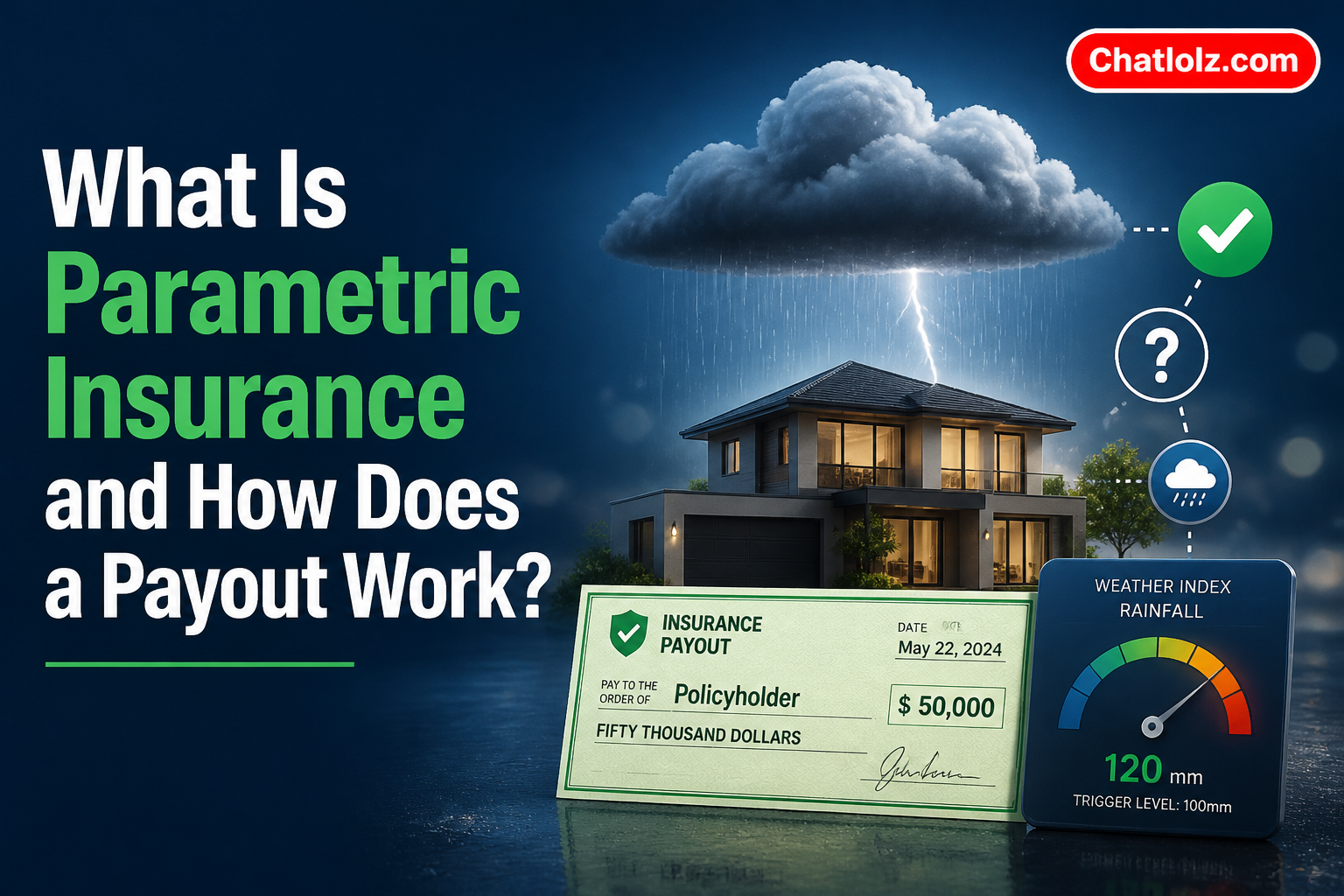
What is parametric insurance and how does a payout work? Parametric insurance pays when a measurable event meets conditions set out in a policy. Rather than first calculating the policyholder’s exact damage, the insurer checks an agreed index—such as rainfall, wind speed, or earthquake intensity—and applies the contract’s payout rules. This can make the trigger and payment calculation easier to understand, but the payout may not match the financial loss. Before buying cover, it is important to know exactly what is measured, where the data comes from, and how the policy turns a measurement into money. Here’s how the process works and what to review.
What Is Parametric Insurance?
Parametric insurance is cover in which a predefined, measurable parameter or index determines whether a payment is due. The contract identifies an event or condition, sets a trigger, and states the payment amount or formula. Unlike a claim based on an assessment of actual loss, payment depends on whether the agreed conditions are met. Swiss Re describes parametric insurance as using a predefined parameter or index to determine whether a policy pays.
The parameter might be rainfall recorded at a named weather station, wind speed measured at a specified location, or a catastrophe indicator defined by the contract. The exact measure matters: “heavy rain” is not enough on its own. The policy should explain which data is used and what level or combination of measurements counts as a trigger.
A parametric policy may offer a fixed payment or use a formula that varies with the measurement. It does not automatically reimburse every expense or replace all property, business, or crop losses. The policy terms determine what is payable.
The Main Parts of a Parametric Policy
Before considering a quote, identify the parts that define the protection:
- Covered peril: The event or condition the policy addresses, such as drought, excessive rainfall, or a windstorm.
- Index or parameter: The variable used to measure the event, such as rainfall total, temperature, wind speed, or earthquake intensity.
- Trigger: The threshold or rule that must be met for payment to become due. A trigger may require a measurement to fall below, exceed, or otherwise satisfy a stated value.
- Measurement source: The named station, dataset, monitoring network, or other source used to establish the reading. The contract should clarify what happens if data is revised, unavailable, or disputed.
- Coverage period and location: The dates and geographic area to which the trigger applies. A reading outside the specified period or location may not count.
- Payout schedule: The fixed payment or calculation method, including whether payments increase across thresholds.
- Limits and exclusions: The maximum benefit and any situations or losses the policy does not cover.
These elements work together. A policy covering a relevant peril may still be a poor fit if the measurement point is far from the insured location or the coverage period misses the risk season. Swiss Re’s overview explains the role of a defined trigger and an agreed method of measurement.
How a Payout Works, Step by Step
The basic process is contractual rather than based on a conventional damage estimate:
| Step | What happens |
|---|---|
| 1. Event | A covered event or condition occurs during the policy’s coverage period. |
| 2. Measurement | The contract’s specified data source records the relevant parameter. |
| 3. Trigger check | The measurement is compared with the policy’s threshold and rules. |
| 4. Payout calculation | The insurer applies the fixed benefit or formula stated in the contract. |
| 5. Payment | If the conditions are satisfied, payment is made under the policy terms. |
For example, a contract might require the insurer to use daily rainfall readings from a named station over a defined month. Once the period ends, the readings are checked against the trigger. If they meet the policy’s conditions, the insurer calculates the payment using the stated schedule. The policy may specify whether the calculation is automatic or whether the insured must submit information or complete another step.
Meeting one threshold does not necessarily mean receiving the maximum benefit. Some contracts use graduated payouts: a modest payment at one level and a larger one if the measurement crosses a more severe threshold. Others state a single fixed amount. The trigger and payment formula—not the severity of a policyholder’s personal loss—control the calculation. The World Bank explains that a trigger does not establish that a payment equals the insured’s total loss.
Hypothetical Example: A Rainfall Policy
This example is hypothetical and does not describe an available product. Suppose a farm buys cover for a particular 30-day growing period. The contract uses rainfall recorded at a specified station and says:
- If rainfall during that period is below 40 millimetres, the policy pays $5,000.
- If rainfall is below 25 millimetres, the policy pays $10,000 instead.
- If rainfall is 40 millimetres or more, there is no payout under this trigger.
If the named station records 32 millimetres, the first threshold is met, so the contractual payment would be $5,000, subject to the policy’s terms. If it records 20 millimetres, the higher threshold applies and the payment would be $10,000. The figures and thresholds are invented solely to illustrate how a schedule can work.
The farm’s actual losses could be higher or lower. Rainfall at the farm might differ from the station reading, for example, or irrigation might reduce the impact. Those circumstances do not necessarily change the parametric calculation unless the policy says they do.
Parametric Insurance Versus Indemnity Insurance
Indemnity insurance generally bases payment on an assessment of covered actual loss, subject to the policy’s coverage, limits, and exclusions. Parametric insurance instead uses a defined index or event trigger to calculate the benefit. Swiss Re explains the distinction and the role of a predefined index.
| Feature | Parametric insurance | Indemnity insurance |
|---|---|---|
| Basis for payment | A specified index, parameter, or event trigger | Assessment of covered actual loss under the policy |
| How the amount is set | A fixed benefit or contractual formula | The covered loss, subject to policy terms and limits |
| Important consideration | Payment may differ from actual loss | The claim depends on loss assessment and coverage terms |
Neither approach is automatically better. Parametric cover can be useful when an objective measure is available and a predefined payment is valuable. Indemnity cover may be more suitable when protection needs to track the value of specific damaged property or another documented loss. Some risk arrangements may combine different forms of cover, but availability depends on the market and policy.
Potential Advantages and the Key Limitation
A clear index can make it easier to understand what must happen for a payment to be due. Because the calculation may not require a full adjustment of physical damage, payment can potentially be quicker than a process that depends on a detailed loss assessment. That is a possibility, not a universal deadline or guarantee: the contract, data availability, verification steps, and applicable rules matter.
The central limitation is basis risk: the possibility that the index-based payment does not correspond to the policyholder’s actual loss. A policy might pay when the index crosses its trigger even if the insured’s loss is limited. Conversely, the insured could suffer significant damage without the specified index reaching the trigger. The payment may therefore be greater than, less than, or unrelated to the actual financial impact. Swiss Re identifies this mismatch as basis risk.
This is why the details of the index matter as much as the headline benefit. Ask whether the data point reflects conditions at the location you want to protect, whether the measurement period fits your exposure, and whether other cover is needed for losses the trigger may not capture.
Where Parametric Cover Is Used
Parametric products are used in disaster and climate-risk contexts, including applications involving weather and natural catastrophes. Potential uses include agricultural risks, where conditions such as rainfall or temperature can affect production, and disaster-risk protection, where a predefined event measure can release funds. The World Bank discusses parametric insurance in climate-risk settings.
Availability, policy design, and applicable regulatory requirements vary by country, insurer, and product. An example familiar in one market may not be offered—or may work differently—in another. Check local terms rather than assuming a trigger, data source, or payout method is standard everywhere.
What to Check Before Buying
Use the policy wording, not just a summary or sales description, to answer these questions:
- What exact peril and index are covered?
- What threshold triggers payment, and are there multiple payout levels?
- Which data source and measurement location control the decision?
- What are the coverage dates and geographic boundaries?
- How is the benefit calculated, and what is the maximum payout?
- What exclusions, conditions, or required actions apply?
- How does the contract handle missing, delayed, corrected, or disputed data?
- When and how is payment made once the trigger is verified?
- What losses could remain uninsured because the index does not match actual conditions?
If any answer is unclear, ask the insurer or a licensed adviser to explain it in writing. Actual triggers, payment amounts, timelines, and regulatory requirements depend on the specific product and location, so a general explanation cannot replace reviewing the policy itself.
Conclusion
Parametric insurance pays according to a measurable trigger written into the contract, not simply according to an estimate of the policyholder’s actual loss. A payout generally follows a sequence: an event occurs, an agreed source measures it, the insurer checks the trigger, and the contract’s payment formula is applied. This structure can make the payment basis transparent and may avoid a full loss adjustment, but it also creates basis risk. Before buying, confirm the index, data source, threshold, coverage period, exclusions, payout schedule, and data-dispute process. The right fit depends on whether the trigger is a reliable proxy for the risk you need to manage.
Frequently Asked Questions
What triggers a parametric insurance payout?
A payout is triggered when the contract’s specified measurement meets its stated threshold or other conditions during the defined coverage period. The policy identifies the parameter and how it is measured.
Does a parametric policy pay for my exact loss?
Not necessarily. Payment follows the policy’s trigger and payout formula, so it may differ from your actual financial loss. This mismatch is called basis risk.
Does meeting the trigger always mean a full payout?
No. The contract may use a fixed benefit, several thresholds, or a graduated payout schedule. The amount depends on the policy terms and measurement.
Is parametric insurance faster than traditional insurance?
It can potentially be quicker because payment may not require a full damage assessment. There is no universal payment deadline; timing depends on the policy and verification process.
What data is used to confirm the trigger?
The contract identifies or defines the measurement source, such as a weather station or dataset. Check how the policy handles missing, revised, or disputed readings.
Where is parametric insurance commonly used?
It is used in some weather, agriculture, natural catastrophe, climate-risk, and disaster-risk contexts. Availability and terms vary by location and product.